
There is rarely a perfect moment to sell an accounting practice. If you sell now, you may wonder whether another year of growth would have produced a better valuation. If you wait, you may discover that the extra time did not create enough value to justify the additional risk, responsibility and delay.
That is why practice-exit timing should not be reduced to a prediction about whether the market will be stronger next year. The better question is whether waiting has a specific job to do.
Can another 12 or 24 months materially improve recurring revenue, profitability, the management team or the practice’s ability to operate without you? Or is the business already attractive, your personal objectives are clear and the main reason for waiting is simply that leaving feels difficult?
The right answer is different for every owner. What matters is comparing the value available today with the realistic value you could create by waiting and then weighing that against the financial and personal risks you continue to carry.
Start With Today, Not Tomorrow
Before deciding whether to wait, establish where you stand today. A current accounting practice valuation gives you a baseline for the decision. Without one, owners can easily compare a real offer today with an imagined, untested value in the future.
A useful timing decision starts with four facts: what the practice is worth now, how transferable it is, what a buyer is likely to worry about, and what you personally want from the exit. Once those are clear, waiting can be treated as an investment decision rather than a default choice.
If you wait one year, what exactly do you expect to be better at the end of that year? The answer should be measurable. ‘Grow a bit more’ is vague. ‘Increase recurring monthly fees, reduce the founder’s client load and appoint a second-tier manager’ is a plan.
When Selling Now Can Make Sense
Selling now does not mean you have stopped believing in the business. It can simply mean that the practice, the buyer market and your own plans are sufficiently aligned that postponing the decision creates more exposure than opportunity.
The practice is performing well
Buyers generally prefer businesses with a credible record of sustainable earnings, recurring work and stable client relationships. A healthy recent trading period can therefore be a good time to explore the market. Waiting for the absolute peak is difficult because peaks are usually obvious only in hindsight.
The business is transferable
A sale becomes easier when clients, workflows and decisions are not concentrated entirely around the owner. Sell Practice’s guide on preparing an accountancy practice for sale highlights the importance of reducing owner dependency, strengthening records and making the business easier for a buyer to take over.
If the team can retain relationships, systems are documented and the practice does not depend on you for every important decision, you may already have solved some of the issues that owners often wait years to address.
Your personal timing is right
A business can be ready before its owner is – and an owner can be ready before the business is. Retirement, family priorities, health, a new venture or simply the desire for less responsibility can all make an earlier exit rational even when future growth remains possible.
The objective is not to capture every final pound of theoretical value. It is to achieve an outcome that works financially while also supporting the life you want after the practice.
When Waiting Can Be Worthwhile
Waiting makes sense when you can identify specific weaknesses that are fixable, valuable to buyers and realistic to improve within a defined period. In that situation, time can be used deliberately to improve both valuation and deal quality.
There is clear value left to build
If the practice has a credible growth plan, another period of improvement may be worthwhile. That could mean increasing recurring work, improving margins, developing advisory revenue or deepening the management team. Our guide to growing an accounting practice before sale explains how organic improvements can strengthen marketability without relying on acquisition-led growth.
The key word is credible. Waiting because revenue might rise is very different from waiting because a signed pipeline, pricing programme or operational change is already producing measurable results.
The practice has obvious sale-readiness gaps
Messy financial records, outdated engagement documentation, weak compliance files or unresolved client concentration can reduce buyer confidence. A structured due diligence checklist can reveal which problems should be resolved before you invite buyers into the business.
If these gaps are likely to lead to a price reduction or difficult negotiations, spending several months fixing them can be more valuable than entering the market quickly.
You are not ready for the transition
A well-planned exit is also a personal transition. Formal exit planning can help you decide how long you want to remain involved, what financial outcome you need and what a successful handover looks like for clients and employees.
Waiting can therefore be sensible when it gives you time to prepare for the change itself not only to improve the numbers.
The Cost of Waiting Is Easy to Underestimate
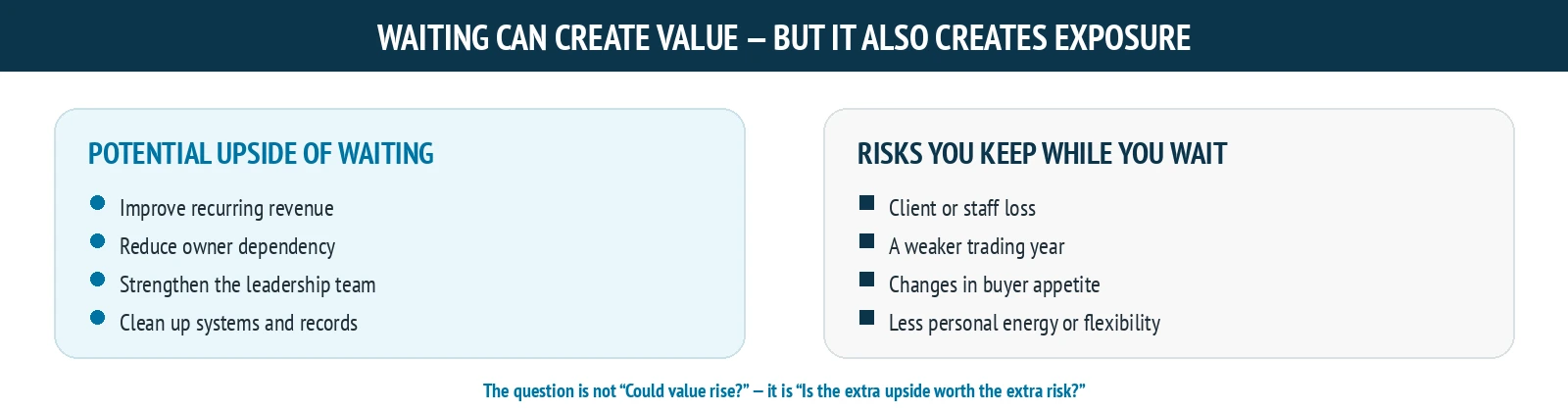
Owners naturally focus on the upside of waiting: another year of profit, a larger fee base or a stronger sale price. The less visible side of the decision is the risk you continue to own during that period.
Performance can change
A major client can leave. A senior employee can resign. Margins can weaken. Technology investment can become necessary. None of these events means the practice is badly run; they are normal business risks. But they matter because the valuation you hope to achieve in two years is not guaranteed.
Buyer appetite can change
Different buyers value practices in different ways. Consolidators and independent acquirers can have different funding, integration and post-sale expectations. Understanding the types of buyers for an accountancy practice helps you judge whether today’s buyer pool already contains credible options rather than assuming a better one will appear later.
Your own appetite can change too
The owner is part of the timing equation. Two more years of growth may look attractive on a spreadsheet, but those two years also mean two more years of staff issues, client responsibility, compliance deadlines and strategic decisions.
If you are already mentally finished with ownership, waiting can damage the very business you are trying to improve. Service quality can slip, investment decisions can be deferred and the team can sense that the owner is no longer fully engaged.
Compare Offers, Not Just Valuations
Timing also affects the structure of the eventual deal. A high headline valuation is not automatically superior if a large proportion depends on client retention or future performance.
When you receive buyer interest, compare cash at completion, deferred consideration, transition obligations and conditions attached to future payments. If an offer includes contingent consideration, understand how earn-outs work in accounting practice sales before deciding that waiting for a higher headline number is automatically better.
Sometimes a clean, well-funded offer today can be more valuable than a theoretically higher offer later with greater conditions and uncertainty. Timing decisions should therefore consider deal certainty as well as valuation.
A Practical Timing Test
A useful way to make the decision is to compare three scenarios: sell now, prepare for a defined period and then sell, or continue operating with no fixed sale date. The middle option is often the most useful because it turns waiting into a project with an end point.
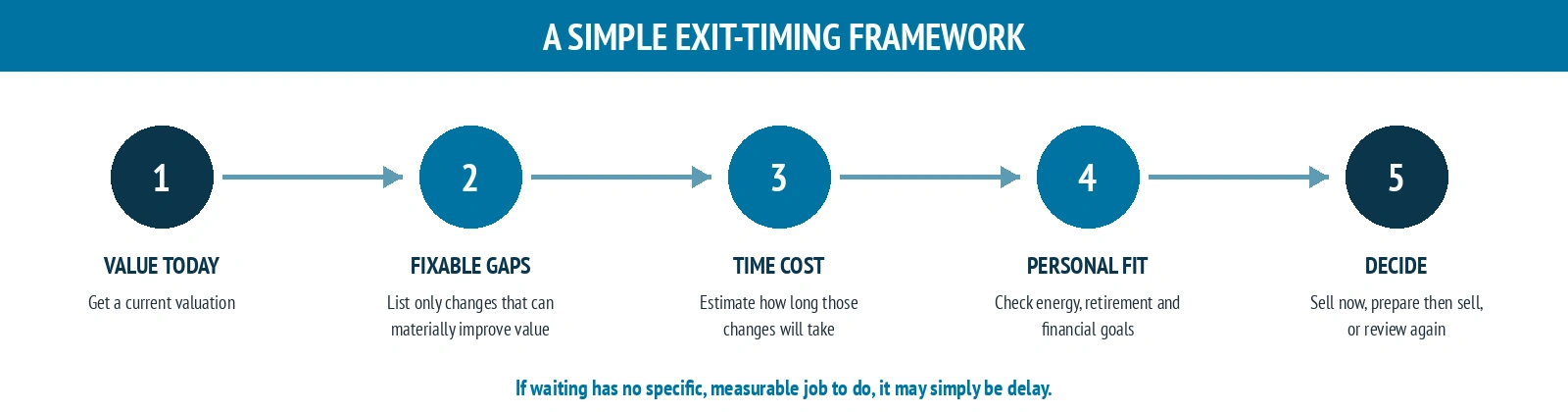
Ask yourself the following questions:
- What is the practice worth today on realistic market assumptions?
- Which weaknesses are genuinely suppressing value?
- Can those weaknesses be materially improved within 6, 12 or 24 months?
- What capital, energy and management attention will the improvements require?
- What could go wrong while I wait?
- What would I do if a suitable buyer made an attractive offer now?
- Am I delaying for strategic reasons — or because the decision is emotionally difficult?
If the case for waiting depends on several uncertain assumptions, the potential extra value may be less compelling than it first appears. If the case is based on a short list of measurable improvements that you can execute confidently, waiting may be a sensible investment.
Prepare Before You Feel Ready to Sell
One of the best ways to avoid a rushed timing decision is to start preparing before you have chosen an exact exit date. Sell Practice’s first-time seller guide and preparation resources both emphasise the value of organised financial information, compliance records and a clear transition plan.
You do not need to put the practice on the market simply because you obtain a valuation or speak to an adviser. Early preparation gives you options. It allows you to understand what buyers may pay today, what they would want improved and whether the gap between today’s value and a future target is worth pursuing.
A specialist accountancy practice broker can also help test buyer appetite confidentially, which is often more useful than trying to judge the market from general headlines.

Should You Sell Now or Wait?
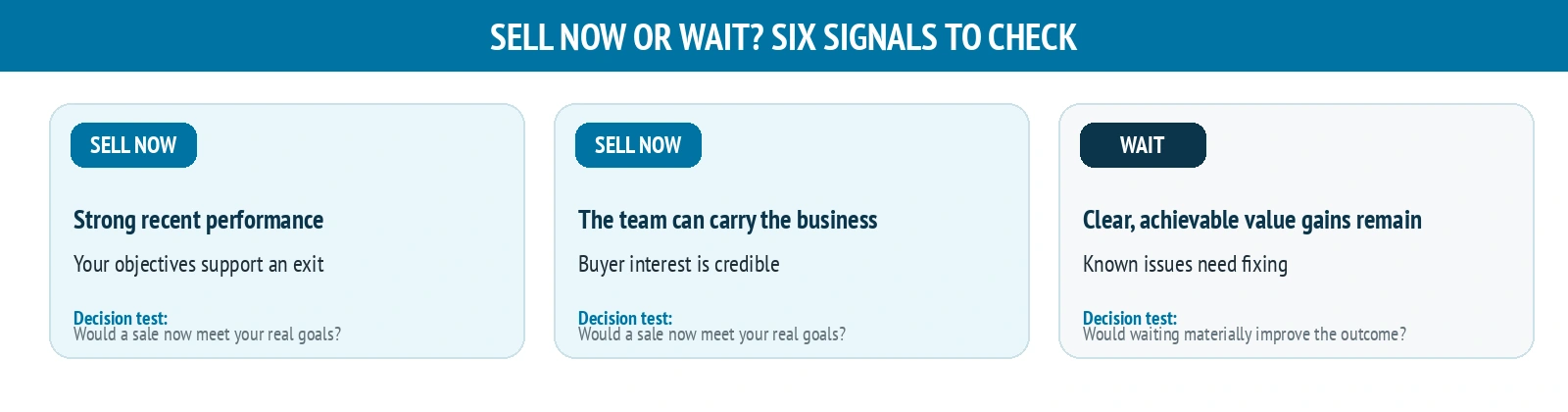
Sell now when the practice is attractive, your objectives are clear, a suitable buyer market exists and waiting has no specific high-value purpose.
Wait when you can identify a small number of realistic improvements that are likely to strengthen valuation, reduce transaction risk or materially improve your eventual exit and when you still have the energy and desire to deliver them.
Most importantly, do not wait simply because selling feels final. A practice exit is a major decision, but delay is also a decision. It keeps your wealth, time and energy exposed to the business for longer.
The strongest timing choice is the one that balances what your practice could become with what it is worth today and what you want your life to look like next.