
Understanding accounting practice valuation is essential if you’re planning to sell your practice, bring in a partner, or simply understand what your business is worth. Many practice owners assume valuation is based solely on annual revenue, but buyers consider a much wider range of factors before deciding how much they are willing to pay.
A valuable accounting practice is one that generates sustainable profits, retains loyal clients, operates efficiently, and can continue performing successfully after ownership changes. These characteristics reduce risk for buyers and often result in stronger offers.
Whether you’re planning to sell in the near future or several years from now, knowing how your practice is valued allows you to make informed decisions that can improve its marketability and maximise its value. This guide explains how accounting practices are valued in the UK, the key factors buyers assess, and what you can do to increase your practice’s worth before going to market.
Key Takeaways
- Accounting practice valuation is influenced by far more than annual revenue.
- Buyers assess profitability, recurring income, client quality, and operational risk.
- Lower-risk practices generally achieve stronger valuations.
- Owner dependency can significantly reduce business value.
- Strong systems, experienced staff, and recurring revenue increase buyer confidence.
- Improving your practice before selling can have a meaningful impact on its valuation.
What Is Accounting Practice Valuation?
Accounting practice valuation is the process of determining the market value of an accounting firm based on its financial performance, operational strength, client base, and future earning potential. Rather than relying on a single formula, buyers assess the overall quality of the practice to determine both its current value and the level of risk involved in acquiring it.
A professional valuation helps practice owners
- Understand the current market value of their business.
- Set realistic expectations before selling.
- Identify opportunities to increase value.
- Support negotiations with prospective buyers.
- Plan an effective exit strategy.
Valuation should not be viewed as a one-time exercise. Regular reviews provide valuable insight into how your practice is performing and where improvements can be made.
Why Accounting Practice Valuation Matters?
Knowing the value of your practice isn’t only important when you’re ready to sell.
An accurate valuation can help with
- Exit planning
- Succession planning
- Partner buy-ins and buy-outs
- Business restructuring
- Strategic growth planning
- Retirement planning
Perhaps most importantly, valuation highlights the strengths and weaknesses of your practice from a buyer’s perspective. This allows owners to improve the areas that have the greatest impact on future sale value before going to market.
How Are Accounting Practices Commonly Valued?
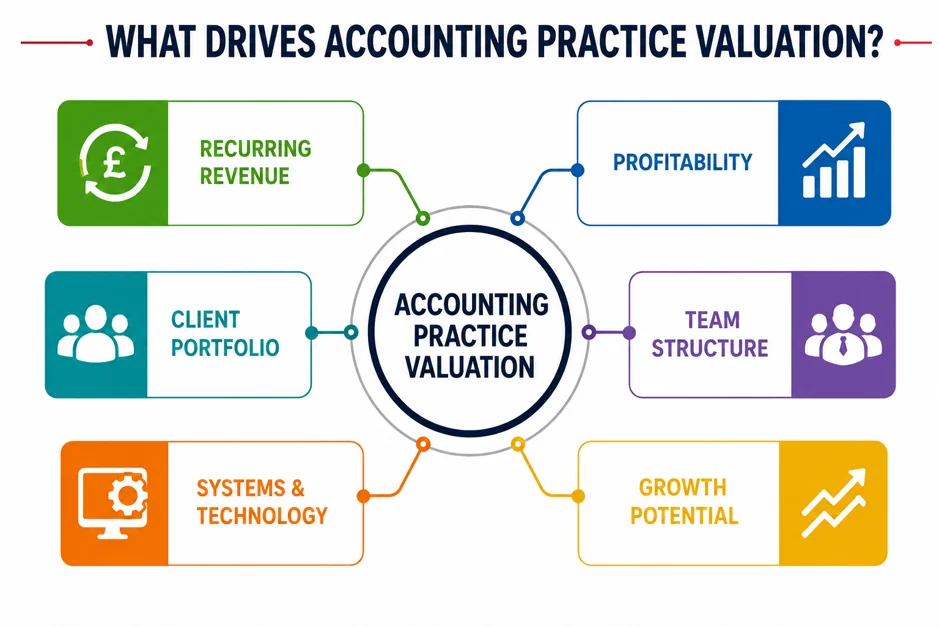
Every practice is different, so there is no universal valuation formula. Instead, buyers consider a combination of financial performance, operational efficiency, market conditions, and business risk.
Rather than asking:
“How much revenue does the practice generate?”
buyers are more likely to ask:
“How reliable is that revenue after the current owner leaves?”
This shift in thinking explains why two practices with similar turnover can achieve very different sale prices. Practices that generate predictable income, retain loyal clients, and operate independently of the owner generally command stronger valuations.
Key Factors That Influence Accounting Practice Valuation
Several factors influence how buyers assess the value of an accounting practice.
Recurring Revenue
Recurring fee income is one of the strongest drivers of practice value. Practices with predictable recurring income are generally viewed as lower-risk investments. Consistent recurring fees also give buyers greater confidence in the practice’s ability to generate stable revenue after the ownership transition.
Examples include
- Annual accounts
- Bookkeeping
- Payroll
- VAT compliance
- Monthly advisory services
A high proportion of recurring revenue provides predictable cash flow and supports long-term business stability.
Profitability
Revenue alone doesn’t determine value. Buyers closely examine how efficiently the practice converts revenue into profit. Healthy and consistent profit margins indicate efficient business operations. Strong profitability also demonstrates that the practice is financially sustainable and capable of delivering reliable returns for a future owner. Practices with stable profitability over several years often attract greater buyer interest than businesses with fluctuating financial performance.
Client Portfolio
The client portfolio represents one of the practice’s most valuable assets. Buyers assess client retention, concentration, industry sectors, and the overall quality of recurring fees. A diverse and loyal client base demonstrates stability and reduces the risk of revenue loss after the ownership transition.
They typically review
- Number of active clients
- Average client fees
- Client retention rates
- Industry diversification
- Dependence on large clients
Practices with well-diversified client portfolios generally present lower acquisition risk. A balanced client base also contributes to more predictable income and long-term business stability.
Owner Dependency
One of the biggest factors affecting valuation is how dependent the practice is on its owner. If most client relationships, operational knowledge, and decision-making rely on one individual, buyers may perceive greater risk.
Reducing owner dependency can involve
- Delegating client relationships
- Empowering senior employees
- Documenting internal procedures
- Developing future leaders
- Standardising workflows
The more independently the practice operates, the more attractive it becomes to buyers. This reduces transition risk and gives buyers greater confidence in the long-term sustainability of the practice.
Team Structure
A capable team contributes significantly to business continuity. Buyers want confidence that employees can continue delivering high-quality service after ownership changes. A capable team that can operate independently often increases buyer confidence. It also demonstrates that the practice can continue delivering consistent service and maintaining client relationships without relying heavily on the current owner. Low staff turnover and experienced managers can positively influence valuation.
Systems and Technology
Modern accounting practices increasingly rely on digital systems to improve efficiency and client service.
Buyers often review
- Practice management software
- Cloud accounting platforms
- Workflow automation
- CRM systems
- Cybersecurity
- Client portals
Practices with efficient systems are generally easier to integrate and scale following an acquisition.¸¸
Growth Potential
Buyers don’t only assess current performance. They also consider future opportunities for growth.
Examples include
- Expanding advisory services
- Cross-selling existing clients
- Geographic expansion
- Improving operational efficiency
- Digital marketing opportunities
- Increasing recurring revenue
Practices with clear opportunities for sustainable growth often achieve stronger valuations than businesses that have reached a plateau.
Common Valuation Methods
There is no single formula used to value every accounting practice. Instead, buyers and specialist advisers apply different valuation methods depending on the size, structure, profitability, and characteristics of the business.
The most common approaches include
-
Recurring Fee Multiple
This is one of the most widely used methods for accounting practice valuation. The valuation is based on a multiple of the practice’s annual recurring fees, with the multiple varying according to factors such as profitability, client retention, growth potential, and overall business risk. While this approach provides a useful benchmark, recurring fees alone do not determine value. Buyers will also consider the quality and sustainability of those fees.
-
Earnings-Based Valuation
Some buyers place greater emphasis on the practice’s profitability rather than revenue alone. This approach focuses on the practice’s ability to generate sustainable earnings and future cash flow. Practices with healthy, consistent profit margins and efficient operations often achieve stronger valuations under this method.
-
Market Comparison
Specialist brokers also consider comparable practice sales within the market. Factors such as practice size, location, service offering, client profile, and current market demand help determine how a practice compares with similar transactions. Using multiple valuation methods provides a more balanced and realistic assessment of a practice’s market value.
How to Increase Your Practice Value Before Selling?
Valuation is not fixed. Many of the factors that influence value can be improved through careful planning. If you’re considering selling in the future, focusing on the following areas can make your practice more attractive to buyers.
- Improve Profitability
Review costs regularly, improve operational efficiency, and focus on increasing sustainable profit rather than simply growing revenue.
-
Increase Recurring Revenue
Expand recurring services such as bookkeeping, payroll, VAT compliance, and advisory work to create more predictable income streams.
-
Reduce Client Concentration
Aim to reduce reliance on a small number of high-value clients by diversifying your client portfolio.
-
Strengthen Client Retention
Maintain strong client relationships through excellent service, regular communication, and proactive advice.
-
Reduce Owner Dependency
Delegate client relationships, develop future leaders, and document internal processes so the business can operate independently.
-
Invest in Technology
Modern systems improve efficiency, reduce operational risk, and make integration easier for future buyers.
-
Develop Your Team
Experienced employees increase buyer confidence and support a smoother ownership transition. Starting these improvements several years before selling often produces the strongest results.

Common Valuation Mistakes
Many practice owners unintentionally reduce the value of their business by misunderstanding how buyers assess risk.
Common mistakes include
- Assuming revenue alone determines value.
- Overestimating the worth of the practice.
- Leaving preparation until the last minute.
- Relying too heavily on the owner.
- Failing to invest in technology.
- Poor financial record keeping.
- High client concentration.
- Weak succession planning.
Recognising these issues early gives owners the opportunity to address them before going to market.
Accounting Practice Valuation Checklist
Use the following checklist to assess whether your practice is well positioned for a future valuation.
| Valuation Area | Why It Matters |
| Recurring revenue | Provides predictable future income |
| Profitability | Demonstrates financial strength |
| Client diversification | Reduces revenue risk |
| Client retention | Supports long-term stability |
| Experienced team | Reduces owner dependency |
| Documented systems | Improves operational efficiency |
| Modern technology | Supports productivity and integration |
| Growth opportunities | Increases future earning potential |
| Exit planning | Strengthens buyer confidence |
How Sell Practice Can Help?
Understanding the value of your accounting practice is the first step towards a successful sale. At Sell Practice, we help owners gain a clear understanding of what drives practice value and how to improve it before entering the market.
Our services include
- Confidential valuation discussions
- Exit planning advice
- Buyer readiness assessments
- Practice sale guidance
- Buyer introductions
- Negotiation support
- Due diligence coordination
Whether you’re planning to sell soon or simply want to understand your practice’s current position, our team can provide specialist guidance tailored to your goals.
Conclusion
A successful accounting practice valuation is about much more than calculating annual revenue. Buyers assess the quality of your recurring income, profitability, client relationships, operational efficiency, team structure, and the overall level of business risk. Understanding these factors allows you to make strategic improvements that strengthen both the value and marketability of your practice.
The earlier you begin preparing, the more opportunities you’ll have to maximise value and achieve a successful outcome when the time comes to sell. If you’re considering your next steps, Sell Practice can provide the expert guidance you need to understand your practice’s value and prepare for a confident, successful sale.