
Most accountancy practice owners do not plan their exit. They drift toward it.
One day, the workload feels heavier than it used to. The regulatory landscape has become more demanding. The energy that once made building the practice exciting is harder to find. And somewhere in the background, a quiet question begins to grow louder: Is it time?
Timing the sale of your accountancy practice is one of the most consequential financial decisions you will ever make. Sell too early and you leave years of income and goodwill on the table. Sell too late and you risk watching your valuation decline as the market moves on without you.
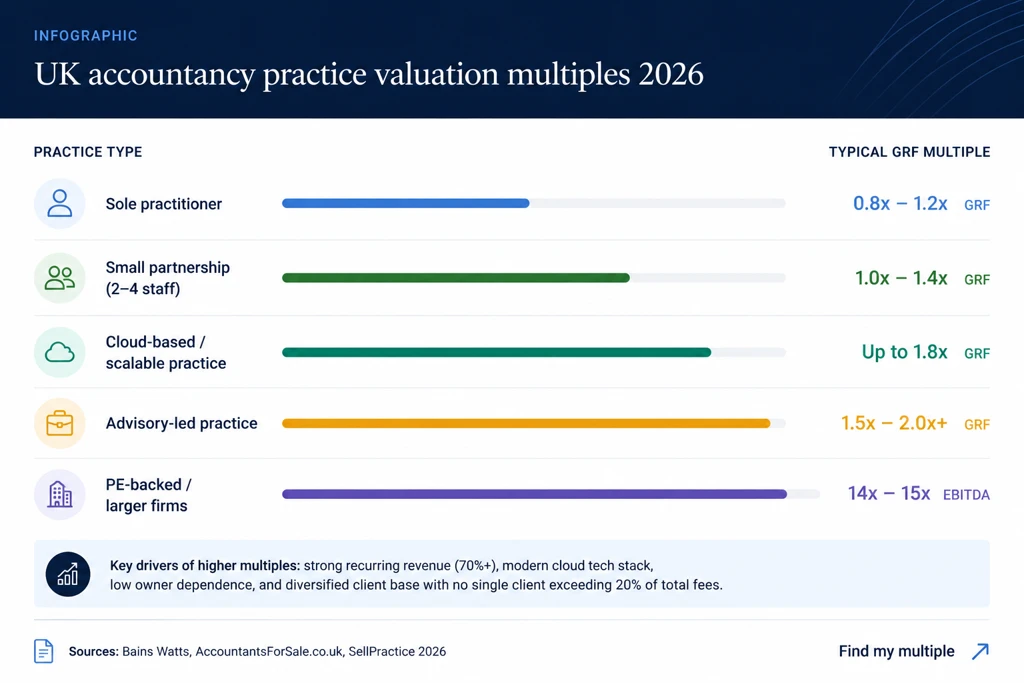
In 2025, UK accountancy practice valuations reached an all-time high, with smaller practices achieving multiples of 14x to 15x EBITDA compared to just 5x or 6x EBITDA only a few years ago. But as of 2026, there is a growing sense in the market that valuations have reached or perhaps just passed the summit, making timing more critical than ever for practice owners considering an exit.
This guide gives you a clear, evidence-based framework for determining whether now is the right time to sell your accountancy practice. It covers the personal signs, the market signals, and the practice health indicators that together tell you whether the timing is right and what to do next.
Key Takeaways
Before you read the full guide, here is what you need to know:
- UK accountancy practice valuations reached all-time highs in 2025, with GRF multiples of 1.4x to 1.8x for high-quality practices
- 2026 is considered a critical year for exits. MTD mandation has arrived, and the market is becoming more selective
- Most accountancy practices sell within 6 months of instruction when prepared correctly
- The right time to sell is determined by personal readiness, market conditions, and practice health, not just age or retirement
- Starting your exit planning 12 to 24 months early consistently produces better financial outcomes
Why Timing Matters More Than You Think
Many practice owners assume that a good practice will always sell for a good price. This is only partially true.
A good practice will always attract buyers. But the price it achieves depends heavily on when it enters the market, what condition it is in at that moment, and what broader market forces are at play.
The 2026 UK accountancy market is more selective than in previous years. Buyers are no longer simply acquiring any fees; they are looking specifically for quality fees, and the gap between compliance-heavy firms and advisory-led firms is widening significantly.
Practices with recurring revenue above 70 percent, low client churn, and strong technology integration are commanding higher multiples, while those that still rely on paper files, outdated processes, or have significant partner dependence are receiving lower offers or extended earnouts.
This means that two practices with identical fee income can achieve very different sale prices depending on the quality and structure of that income and the timing of when they come to market.
Understanding where your practice sits in this landscape is the starting point for any honest assessment of whether now is the right time to sell.
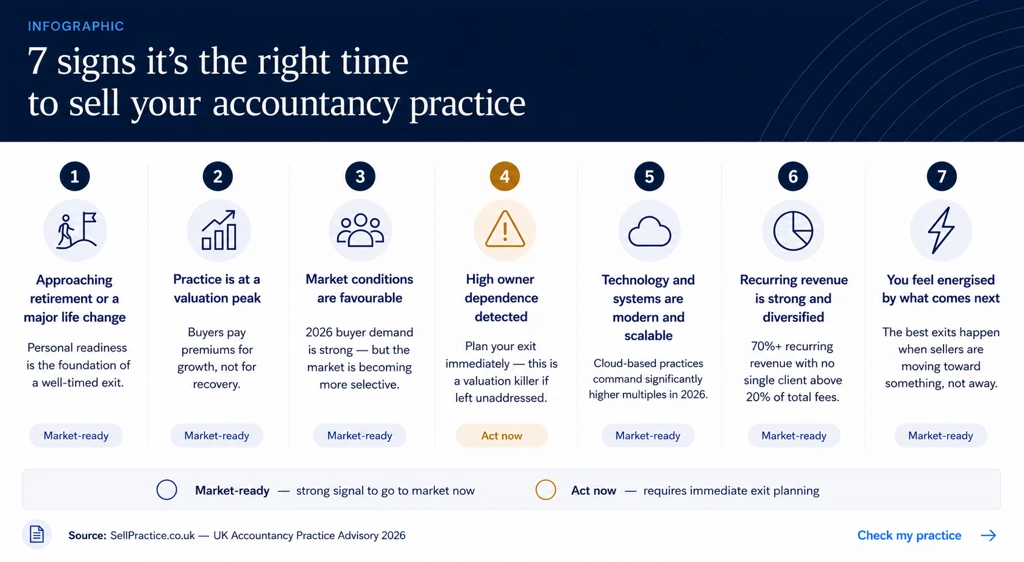
7 Signs It Is the Right Time to Sell Your Accountancy Practice
Sign 1: You Are Approaching Retirement or a Major Life Change
The most obvious signal that it is time to consider selling is personal. If you are approaching retirement age, planning a significant life change, or simply reaching the point where the practice no longer aligns with where you want your life to go, that is a legitimate and sufficient reason to begin the exit process.
The mistake many practice owners make is waiting until they are completely ready to stop working before starting the sale process. By then, the preparation window has closed. The most financially rewarding exits are planned 12 to 24 months in advance, giving the seller time to optimize the practice’s saleability before going to market.
If retirement is on your horizon within the next three years, the right time to begin exit planning is now. The [SellPractice exit planning service](https://sellpractice.co.uk/services/exit-planning/) is designed precisely for this stage, helping practice owners build a structured exit roadmap long before any formal sale process begins.
Sign 2: Your Practice Is at a Valuation Peak
Selling when your practice is performing strongly, not when it has started to decline, is one of the most important principles of exit timing.
The most common mistake practice owners make is waiting until fees have plateaued or started to dip before deciding to sell. In 2026, that is a risky strategy. The most aggressive buyers are looking for growth, not recovery.
Buyers pay a premium for practices that are growing or stable. They apply a discount to practices that are declining, even modestly. A practice that has been growing at 5 percent per year for the past three years will achieve a meaningfully higher multiple than one that has been flat or contracting even if the current fee income is identical.
If your practice is currently performing well, that is the optimal moment to bring it to market. Waiting for it to perform even better risks missing the window.
Sign 3: The Market Conditions Are Favourable
Personal readiness and practice health matter enormously, but market conditions also play a significant role in determining your eventual sale price.
A significant rise in mergers and private equity activity is expected in the UK accountancy sector, driven by the need to scale and diversify, creating strong buyer demand for quality practices.
Making Tax Digital mandation arrives in April 2026 for businesses with gross income exceeding £50,000, creating a significant operational shift across the sector. Smart buyers are already modeling their acquisitions around the 2027 and 2028 MTD thresholds, and waiting until 2028 to sell risks having a portion of your recurring fees viewed as a liability rather than an asset.
In practical terms, the current market has strong buyer demand, historically high multiples, and a regulatory backdrop that creates genuine urgency for buyers to complete acquisitions before further MTD obligations arrive. These conditions will not remain indefinitely.
For an up-to-date view of what is currently available and transacting in the market, the SellPractice practices for sale page gives you real insight into current buyer appetite and deal activity.
Sign 4: You Have High Owner Dependence
This sign works differently from the others. High owner dependence is not a reason to sell immediately it is a reason to act urgently on your exit planning.
Buyers are increasingly concerned about key man risk. They want to buy a practice that has a settled, capable team or a systematized workflow that does not rely on the retiring partner’s knowledge. Firms with modern, offshore components or highly automated processes are commanding premiums, while owner-dependent practices are harder to sell and attract lower multiples.
If you recognise that your practice’s client relationships, revenue, and operations are heavily dependent on your personal involvement, you have two choices. You can begin a 12 to 24 month programme of reducing that dependence before going to market. Or you can accept that your valuation will reflect the additional risk buyers are taking on and price accordingly.
Either way, recognising this now gives you options. Recognising it after you have already decided to sell gives you very few.
The SellPractice growth advisory service helps practice owners systematise their operations and reduce owner dependence as part of a structured pre-sale improvement programme.
Sign 5: Your Technology Stack Is Modern and Scalable
In 2026, accountancy practice buyers are tech-native. They want to integrate your fees into their existing cloud ecosystems, Xero, QuickBooks, and Dext, with minimal friction. A paper-based, manual practice is seen as a turnaround project, and turnaround projects come with discounted price tags.
If your practice has made the transition to cloud-based tools, automated client onboarding, and digital workflow management, you are significantly more attractive to the current buyer pool. About 62.7 percent of UK accountancy firms now run a hybrid desktop and cloud model, and practices that have moved further toward full cloud adoption are commanding higher multiples in the current market.
Conversely, if your practice is still primarily paper-based or relies on legacy systems, this is a valuation issue worth addressing before going to market and a signal that your exit planning should begin now rather than later.
Sign 6: Your Recurring Revenue Is Strong and Well-Diversified
Recurring, contracted fee income is the most valuable component of any accountancy practice in the current market.
Firms that have successfully moved their clients onto fixed-fee monthly packages are seeing much smoother practice sale transitions. Buyers want to know that the day after the deal closes, the money will keep rolling in. High recurring fees reduce the risk of client attrition during the handover, making your firm a much more attractive prospect.
If your practice has strong recurring revenue typically defined as 70 percent or more of total fee income and that income is well-diversified across a broad client base with no single client representing more than 15 to 20 percent of total fees, you are in an excellent position to go to market.
For an independent assessment of how your practice’s recurring revenue profile affects its valuation, the SellPractice valuation service provides a market-based analysis built specifically for UK accountancy practices.
Sign 7: You Feel Energised by What Comes Next
This final sign is the most personal and the one most frequently underestimated.
The best exits happen when the seller is moving toward something, not just away from something. Whether that is retirement, a portfolio career, another business venture, or simply more time for the things that matter most, having a clear and compelling vision of what comes after the sale dramatically improves both the quality of the decision and the quality of the experience.
Sellers who are genuinely excited about what comes next are also more likely to approach the sale process with the energy and engagement it requires. They invest in preparing the practice properly. They communicate confidently with buyers. They manage the transition with care.
If you find yourself energized by the prospect of what comes next, that is a strong signal that the timing is right.
The True Cost of Waiting Too Long
One of the most common conversations the SellPractice team has with practice owners is with those who waited longer than they should have.
The story is almost always the same. The practice began to plateau. Energy levels dropped. New regulatory requirements MTD, ICAEW compliance updates, technology transitions began to feel more burdensome than manageable. By the time the decision to sell was made, the practice was no longer the high-performing asset it once was.
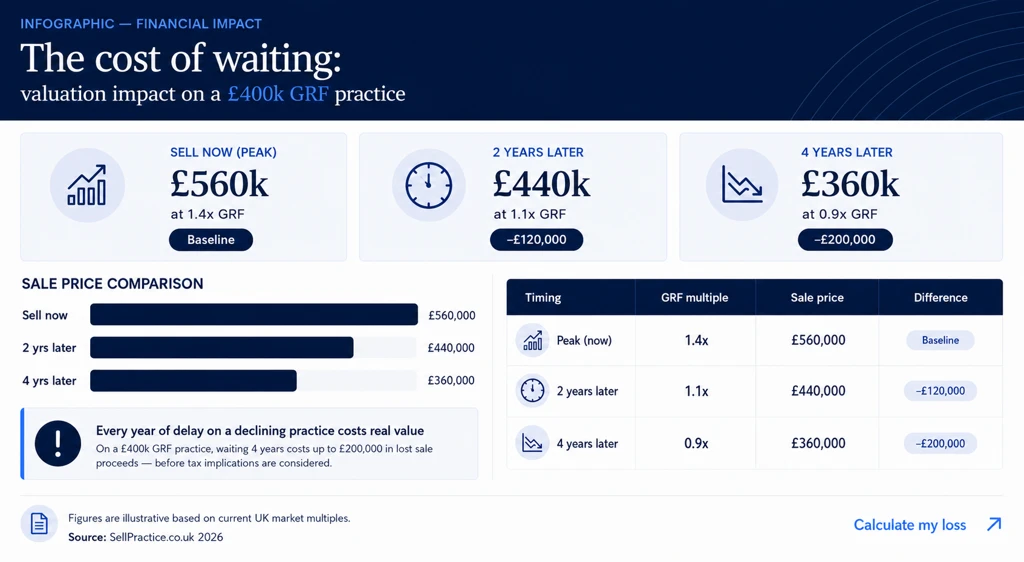
The financial cost of this is significant. A practice that would have commanded a 1.4x GRF multiple at its peak might achieve 0.9x or 1.0x once decline has set in. On a practice with £400,000 in annual recurring fees, that difference represents £160,000 to £200,000 in lost sale proceeds.
The personal cost is equally real. Selling from a position of fatigue rather than strength is a fundamentally different experience. Negotiations feel harder. The transition feels heavier. And the sense of satisfaction that should accompany the culmination of a career’s work is diminished.
Selling at the right time when the practice is performing well, when you have energy for the process, and when market conditions are favourable consistently produces better outcomes on every dimension.
What to Do When the Signs Point to Selling
If you have read this guide and recognise several of the signs above, here is your immediate action plan.
Step 1: Get an independent valuation.
Before making any decision, understand what your practice is actually worth in the current market. Not what you feel it is worth. Not what a colleague said a similar practice sold for three years ago. A current, market-based valuation from a specialist advisor gives you the factual foundation for every decision that follows.
Step 2: Begin exit planning.
Even if you are not ready to sell for 12 to 24 months, starting the exit planning process now gives you the opportunity to address the structural factors that most affect your valuation. The SellPractice exit planning service is built for exactly this stage.
Step 3: Engage a specialist advisor.
The difference between a generalist broker and a specialist accountancy practice advisor is not a matter of preference. It is a matter of financial outcome. Specialist advisors have the sector knowledge, buyer networks, and transaction experience to achieve consistently better results. The SellPractice brokerage service works exclusively with accountancy and financial services firms in the UK.
Step 4: Review your practice health.
Use the seven signs in this guide as a checklist. Where you identify weaknesses owner dependence, low recurring revenue, outdated technology address them systematically before going to market. Every improvement you make translates directly into a better sale price.
Step 5: Plan your confidential sale.
When you are ready to go to market, do so through a managed, confidential process that protects your practice’s goodwill throughout. For a view of what is currently transacting in the market, visit the SellPractice sell accounting practice page
Conclusion
Knowing when it is the right time to sell your accountancy practice is not about finding a perfect moment. It is about recognising when the personal signals, the practice health indicators, and the market conditions are sufficiently aligned to make a move.
The practice owners who achieve the best outcomes are not those who sell at precisely the right moment by chance. They are the ones who plan their exit thoughtfully, prepare their practice systematically, and work with specialist advisors who understand what buyers in the current market are looking for.
If several of the signs in this guide resonate with where you are today, the right time is closer than you might think.
SellPractice works exclusively with UK accountancy and financial services firm owners at every stage of the exit journey. From initial valuation and exit planning through to brokerage, negotiation, and post-completion transition, the team is ready to help you sell at the right time, for the right price, on your terms.