
Selling an accountancy practice is one of the most significant financial and professional decisions a practice owner will make.
Whether you are planning for retirement, exploring a merger opportunity, reducing your involvement in the business, or simply looking to realise the value you have built over many years, the sale process requires far more than finding a buyer and agreeing on a price.
Many practice owners focus heavily on valuation and attracting potential buyers, but often overlook the mistakes that can significantly reduce the value of their practice or delay a successful transaction. In some cases, these mistakes can even cause a sale to collapse entirely.
The reality is that even highly profitable and well-established accountancy practices can underperform during a sale because of poor preparation, unrealistic expectations, weak buyer selection, inadequate due diligence, or confidentiality issues.
The good news is that most of these mistakes are entirely avoidable.
By understanding the common pitfalls and taking a structured approach to the sale process, practice owners can improve buyer confidence, maximise value, and ensure a smoother transition for clients, staff, and stakeholders.
In this guide, we’ll explore the most common mistakes accountancy practice owners make when selling and explain how to avoid them to achieve the best possible outcome.
Key Takeaways
Before diving into the details, here are the most important lessons every practice owner should understand:
- Start planning your exit strategy well before you intend to sell.
- Obtain an independent valuation based on market realities.
- Focus on deal structure as well as headline sale price.
- Choose the right buyer, not necessarily the highest bidder.
- Reduce owner dependency before going to market.
- Prepare thoroughly for due diligence.
- Protect client confidentiality throughout the transaction.
- Work with specialist advisors to maximise value and reduce risk.
Why So Many Accountancy Practice Sales Underperform
Many practice owners assume that if their firm is profitable and has a loyal client base, a successful sale will naturally follow.
Unfortunately, that is not always the case.
Buyers assess much more than revenue and profit figures. They evaluate risk, client retention, staff stability, operational efficiency, growth opportunities, and how dependent the practice is on the current owner.
As a result, two practices with similar fee income can achieve dramatically different sale outcomes.
The most common reasons accountancy practice sales underperform include:
- Poor preparation before going to market
- Unrealistic valuation expectations
- Lack of buyer qualification
- Weak deal structures
- Inadequate due diligence preparation
- Poor communication planning
- Confidentiality breaches
- Attempting to manage the process without professional support
The impact of these mistakes can be substantial.
A poorly managed sale often results in lower offers, extended transaction timelines, increased stress, and a higher risk of client or staff attrition.
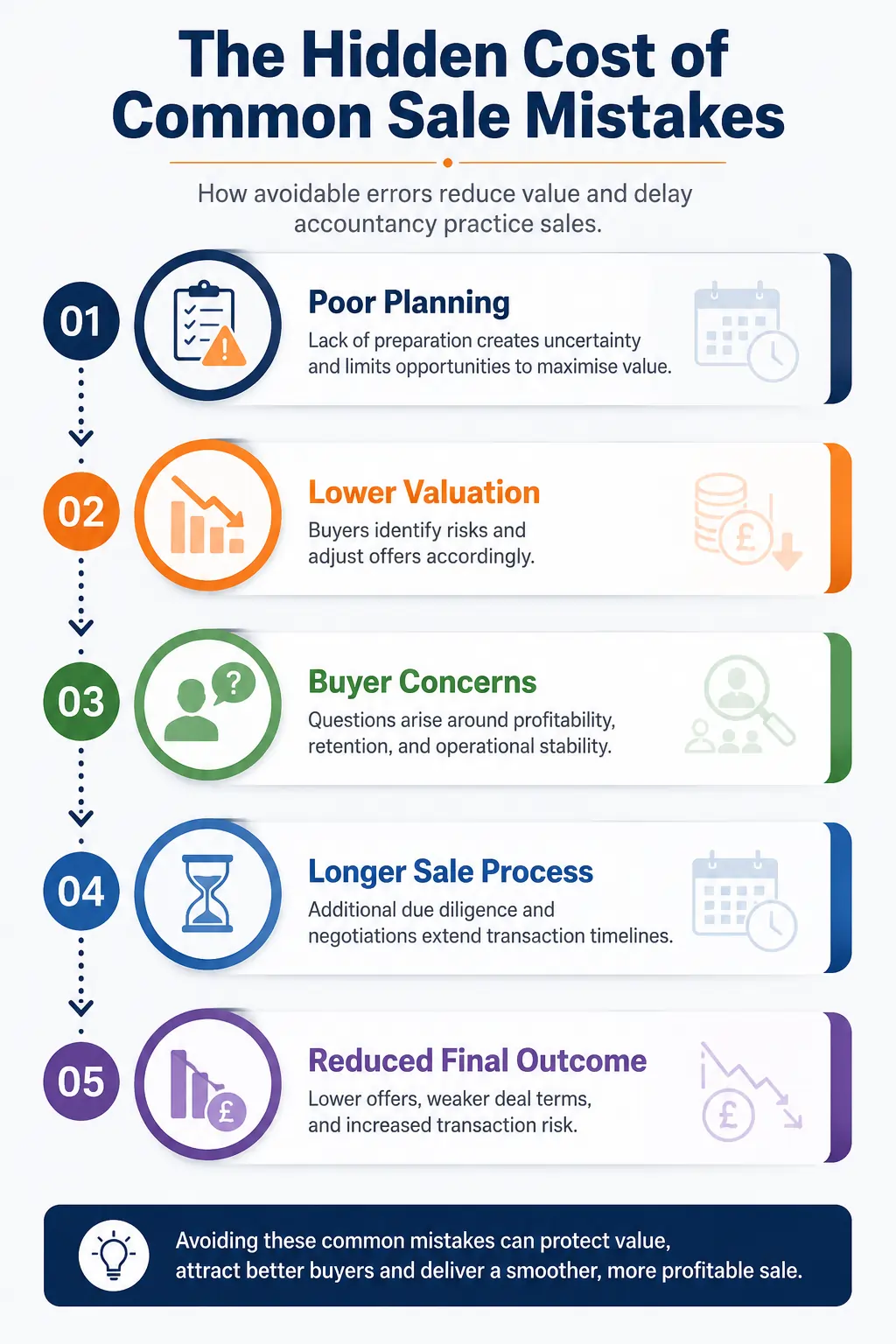
Why This Matters
The most successful practice sales rarely happen by accident.
They are usually the result of careful planning, realistic expectations, and a structured process designed to protect value while reducing risk.
Mistake 1: Waiting Too Long to Start Planning
One of the most common mistakes practice owners make is delaying sale preparation until they are ready to leave the business.
Many owners assume they can begin planning once retirement approaches or when they decide it’s time to move on.
However, by that stage, opportunities to improve value may already be limited.
Why Timing Is Critical
Preparing an accountancy practice for sale is not something that can be completed in a few weeks.
Many of the factors that influence valuation require time to improve, including:
- Client retention rates
- Profitability
- Staff development
- Recurring revenue quality
- Operational efficiency
- Owner dependency
Practices that begin preparing one to three years before a planned exit often achieve significantly stronger outcomes.
This provides time to identify weaknesses, implement improvements, and present the practice in the best possible position when buyers begin their assessment.
Common Consequences of Delayed Planning
When owners leave preparation too late, they often face:
- Lower valuations
- Fewer buyer options
- Reduced negotiating power
- Increased transaction pressure
- Greater risk of sale delays
How to Avoid This Mistake
Start planning your exit strategy as early as possible.
Key actions include:
- Reviewing valuation drivers
- Assessing operational risks
- Improving profitability
- Reducing owner dependency
- Strengthening client retention
- Creating a clear succession plan
Why This Matters
The best time to prepare for a sale is often years before you intend to exit.
Preparation creates options, and options create value.
Mistake 2: Overestimating the Value of the Practice
Many accountancy practice owners have invested years of effort into building their business.
As a result, it is understandable that emotional attachment can influence expectations regarding value.
Unfortunately, buyers assess value very differently.
Emotional Attachment vs Market Reality
Owners often focus on:
- Years of hard work
- Long-standing client relationships
- Personal reputation
- Historical achievements
Buyers focus on:
- Future income
- Risk
- Profitability
- Client retention
- Growth opportunities
The difference between these perspectives can create unrealistic valuation expectations.
Common Valuation Misconceptions
Some owners assume:
- Revenue alone determines value
- Longevity guarantees a premium
- Every client relationship will transfer
- Buyers will pay for historical performance
In reality, buyers are purchasing future earnings and future opportunity.
Key Risk Factors Buyers Consider
Several risks can reduce value, including:
- Client Concentration
If a small number of clients generate a large percentage of revenue, buyers may perceive higher risk.
- Owner Dependency
If clients rely heavily on the owner, retention after completion becomes less certain.
- Staff Retention Concerns
Experienced employees often play a critical role in client relationships and operational continuity.
- Limited Growth Opportunities
Buyers generally prefer practices that offer clear opportunities for expansion and development.
How to Avoid This Mistake
The best approach is to obtain a professional valuation before going to market.
This provides:
- Realistic expectations
- Market-based benchmarks
- Insight into valuation drivers
- Opportunities for improvement before sale
Expectations vs Market Reality
| Seller Assumption | Buyer Perspective |
|---|---|
| Revenue drives value | Profitability drives value |
| Long history guarantees value | Future income matters most |
| Clients will automatically stay | Retention risk must be assessed |
| Highest valuation wins | Sustainability determines price |
Why This Matters
A realistic valuation helps attract serious buyers, supports negotiations, and increases the likelihood of a successful transaction.

Mistake 3: Focusing Only on Price, Not Deal Structure
When selling an accountancy practice, many owners become fixated on the headline number attached to an offer.
While the purchase price is undoubtedly important, it is only one component of the overall transaction.
In many cases, a lower offer with better terms can be more valuable than a higher offer with significant risks attached.
Why Deal Structure Matters
Most practice sales involve some combination of:
- Upfront payments
- Deferred consideration
- Earn-out arrangements
- Client retention clauses
- Transition support agreements
The way these elements are structured can significantly affect the final amount a seller receives.
For example, an offer of £800,000 may initially appear more attractive than an offer of £750,000. However, if £300,000 of the higher offer depends on client retention targets over several years, the lower offer may actually provide greater certainty and lower risk.
Key Areas to Evaluate
- Upfront vs Deferred Payments
The proportion of funds paid on completion versus future payments can dramatically affect risk.
- Earn-Out Arrangements
These are often linked to client retention and future performance.
- Risk Allocation
Understanding who carries the risk if clients leave after completion is essential.
How to Avoid This Mistake
- Evaluate the entire transaction, not just the headline figure.
- Understand payment timing and conditions.
- Consider the risks attached to deferred payments.
- Seek professional advice before accepting any offer.
Why This Matters
The best deal is not always the highest offer.
The strongest transactions balance value, certainty, and risk.
Mistake 4: Choosing the Wrong Buyer
Not all buyers are equal.
Many practice owners assume that the highest bidder is automatically the right choice.
In reality, choosing the wrong buyer can create significant challenges for clients, staff, and the long-term success of the practice.
Common Buyer Risks
- Poor Cultural Fit
Different service approaches and management styles can disrupt client relationships.
- Weak Integration Capability
Some buyers struggle to absorb acquired practices effectively.
- Limited Client Retention Strategy
If the buyer does not have a clear transition plan, client attrition becomes more likely.
- Financial Uncertainty
A buyer’s ability to complete the transaction should always be assessed carefully.
How to Avoid This Mistake
Focus on strategic alignment rather than price alone.
Consider:
- Industry experience
- Client service philosophy
- Financial stability
- Growth plans
- Team integration capability
Why This Matters
The right buyer helps protect client relationships, staff retention, and the reputation you’ve spent years building.
Mistake 5: Being Too Dependent on the Owner
One of the biggest valuation risks in accountancy practice sales is excessive owner dependency.
Many practices are built around the relationships, expertise, and reputation of a single individual.
While this may have contributed to growth over the years, it can become a significant concern during a sale.
Why Buyers Worry About Owner Dependency
Buyers need confidence that the practice can continue operating successfully after ownership changes.
If clients only deal with the owner, buyers may question:
- Client retention rates
- Revenue sustainability
- Transition risk
- Future growth potential
Common Signs of Owner Dependency
- Clients contact only the owner.
- Key decisions cannot be made without the owner.
- Relationships are not shared across the team.
- Business processes are undocumented.
How to Avoid This Mistake
- Delegate Client Relationships
Introduce senior team members to key clients before the sale.
- Strengthen Internal Management
Reduce reliance on one individual for decision-making.
- Document Processes
Create operational procedures that support continuity.
- Build Team Visibility
Allow staff to take ownership of client relationships where appropriate.
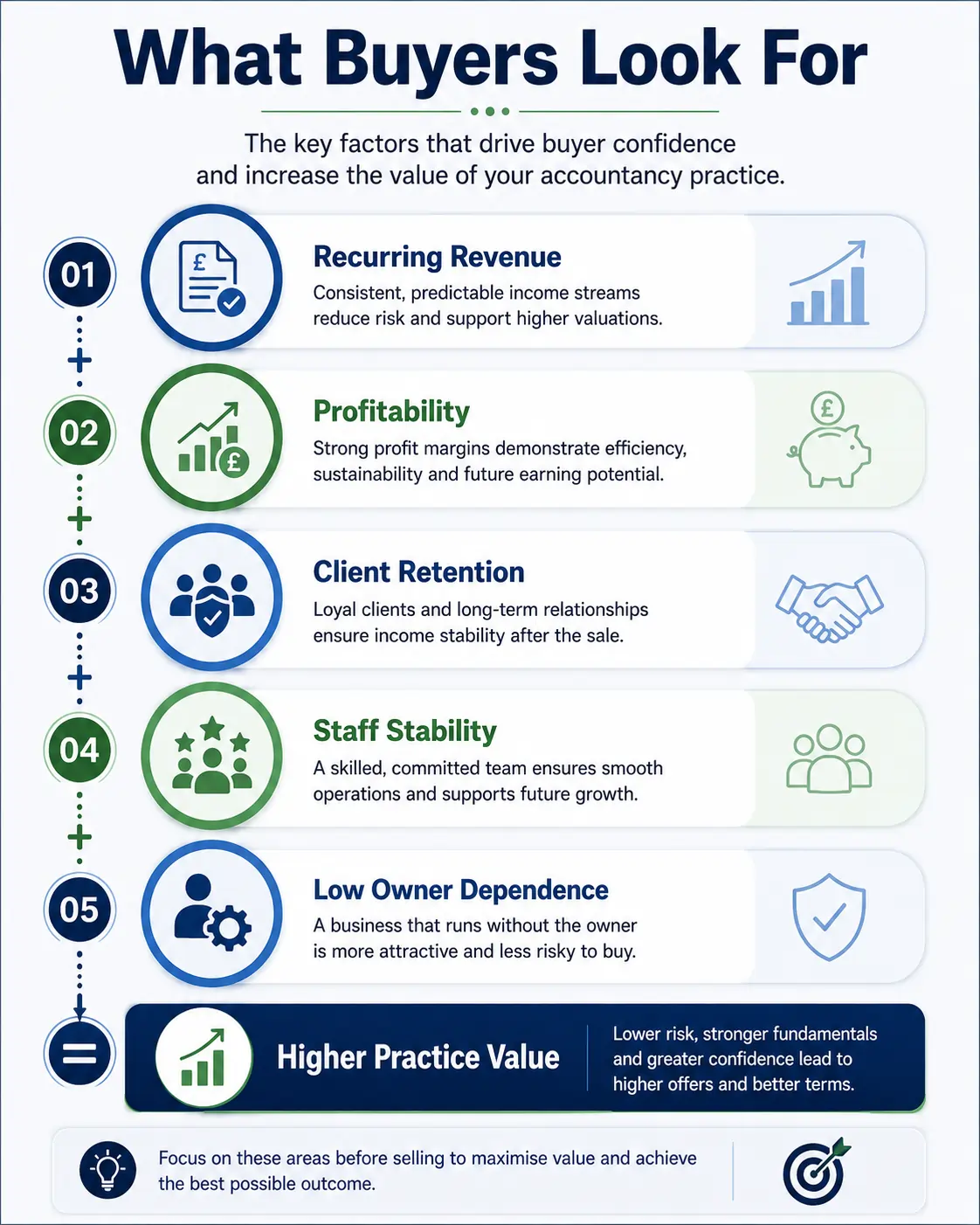
Why This Matters
The more transferable a practice becomes, the more attractive it becomes to potential buyers.
Reducing owner dependency often leads to stronger valuations and smoother transitions.
Mistake 6: Poor Preparation for Due Diligence
Due diligence is one of the most important stages of any practice sale.
This is where buyers examine the practice in detail to verify the information provided during negotiations.
Poor preparation can slow the process, reduce buyer confidence, and even cause transactions to collapse.
Common Due Diligence Issues
- Disorganised Financial Records
Incomplete or inconsistent reporting creates uncertainty.
- Missing Client Agreements
Buyers want clarity regarding service arrangements and recurring income.
- Incomplete Compliance Documentation
Regulatory and professional compliance records must be available.
- Weak Operational Reporting
Buyers need visibility into performance and processes.
How to Avoid This Mistake
Prepare documentation well before going to market.
Organise:
- Financial statements
- Client records
- Service agreements
- Staff documentation
- Compliance records
- Operational procedures
Why This Matters
Well-prepared sellers create confidence.
Confident buyers move faster and negotiate from a stronger position.
Mistake 7: Ignoring Client and Staff Transition Planning
Many practice owners focus heavily on finding a buyer but pay insufficient attention to what happens after completion.
However, client retention and staff continuity often determine the long-term success of the transaction.
Key Risks
- Client Attrition
Clients may become concerned if communication is poorly managed.
- Staff Uncertainty
Employees may worry about future changes.
- Service Disruption
A poorly planned handover can affect service quality.
How to Avoid This Mistake
- Create a Client Communication Strategy
Plan when and how clients will be informed.
- Support Staff Throughout the Process
Provide reassurance and clarity where appropriate.
- Ensure Continuity
Maintain key relationships during the transition period.
Why This Matters
The smoother the transition, the greater the likelihood of client retention and successful integration.
Mistake 8: Breaching Confidentiality
Confidentiality is one of the most important aspects of any accountancy practice sale.
Premature disclosure can create uncertainty, damage trust, and negatively affect practice value.
Risks of Poor Confidentiality Management
- Client concern
- Staff uncertainty
- Competitive exposure
- Reduced buyer confidence
How to Avoid This Mistake
- Use Non-Disclosure Agreements (NDAs)
Ensure buyers sign confidentiality agreements before receiving sensitive information.
- Screen Buyers Carefully
Only share detailed information with qualified prospects.
- Control Information Flow
Disclose information gradually throughout the transaction.
- Follow a Structured Process
Professional sale processes help protect all parties involved.
Confidential Sale vs Poorly Managed Sale
| Confidential Process | Poorly Managed Process |
|---|---|
| NDA protection | No confidentiality controls |
| Buyer screening | Open information access |
| Controlled disclosure | Excessive disclosure |
| Stable clients | Increased uncertainty |
| Higher buyer confidence | Reduced trust |
Why This Matters
Maintaining confidentiality protects your reputation, your clients, and ultimately the value of your practice.
Mistake 9: Trying to Manage the Sale Alone
Selling an accountancy practice is a specialised transaction.
Yet many owners attempt to manage the process without professional support.
While this may seem like a way to save costs, it often creates additional risks and challenges.
Common Problems
- Limited access to qualified buyers
- Weak negotiation position
- Poor deal structuring
- Increased transaction risk
- Longer completion timelines
How to Avoid This Mistake
Work with specialists who understand:
- Practice valuations
- Buyer behaviour
- Deal structuring
- Due diligence
- Confidentiality management
- Transition planning
Selling Alone vs Using a Specialist Advisor
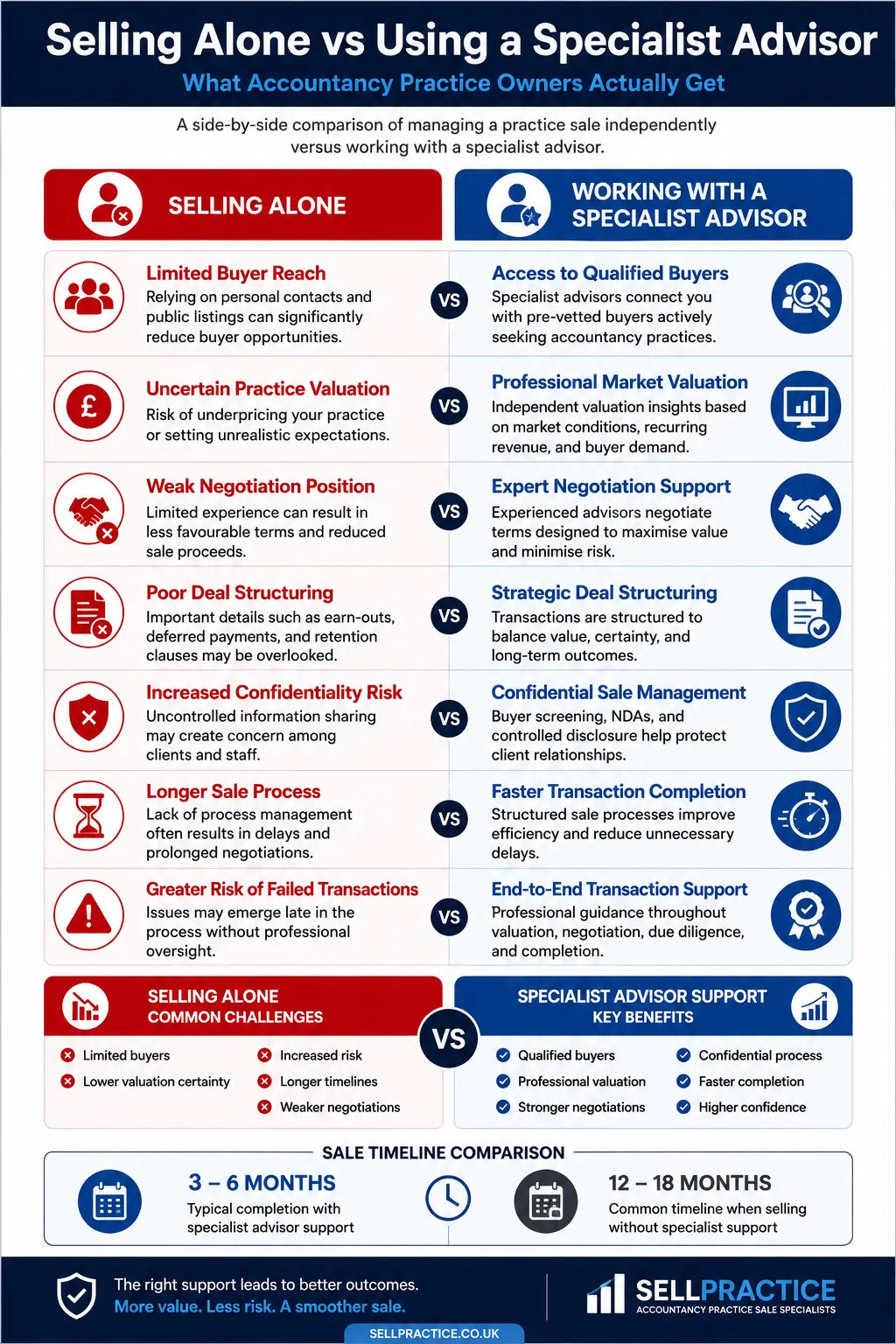
Without Specialist Support
- Limited buyer reach
- Weak negotiation position
- Increased confidentiality risks
- Longer transaction timelines
With Specialist Support
- Access to qualified buyers
- Professional valuation guidance
- Strong confidentiality controls
- Efficient transaction management
Why This Matters
The right advisor can help reduce risk, improve buyer quality, and maximise overall transaction value.
Case Study: How Early Preparation Increased Practice Value
A practice owner in the South East planned to retire within three years and wanted to achieve the strongest possible outcome from the sale.
Initially, the practice faced several challenges:
- Heavy reliance on the owner for client relationships
- Limited documentation of internal processes
- Inconsistent management reporting
- A client base concentrated around a small number of key accounts
Rather than rushing to market, the owner began preparing two years before the planned exit date.
The practice focused on:
- Delegating client management responsibilities
- Improving recurring revenue streams
- Strengthening management reporting
- Documenting operational procedures
- Diversifying client concentration risk
By the time the practice was marketed:
- Profitability had improved
- Client retention was stronger
- Buyer confidence had increased
- Multiple offers were received
Most importantly, the owner achieved a valuation significantly higher than originally anticipated.
Why This Matters
The difference wasn’t luck.
It was preparation.
Many of the factors that influence value can be improved long before a practice reaches the market.
How SellPractice Helps Avoid These Mistakes
Selling an accountancy practice is a complex process that requires careful planning, specialist knowledge, and structured execution.
At SellPractice, we help accountancy practice owners avoid the common mistakes that often reduce value and delay transactions.
Our goal is simple:
To maximise value, minimise risk, and deliver a smooth transition.
Accurate Practice Valuations
Many owners enter the market with unrealistic expectations.
Our valuation services provide:
- Independent assessments
- Market-based insights
- Valuation benchmarking
- Identification of improvement opportunities
This helps sellers understand what buyers are really looking for and how to position their practice effectively.
Access to Qualified Buyers
Finding the right buyer is just as important as finding a buyer.
SellPractice connects sellers with:
- Strategic acquirers
- Growing accountancy firms
- Private investors
- Regional consolidators
All buyers are carefully screened to ensure suitability and capability.
Confidential Sale Management
Confidentiality is critical throughout the transaction.
Our structured process includes:
- Buyer qualification
- Non-disclosure agreements
- Controlled information sharing
- Secure communication channels
This protects client relationships and preserves practice value.
Deal Structuring Support
The best deal is not always the highest offer.
We help sellers evaluate:
- Payment structures
- Earn-out arrangements
- Deferred consideration
- Risk allocation
- Transition support agreements
This ensures the transaction aligns with your personal and financial objectives.
Due Diligence Preparation
Preparation is one of the biggest drivers of successful outcomes.
We assist with:
- Financial documentation
- Client information preparation
- Compliance records
- Operational reporting
- Data room organisation
A well-prepared practice inspires buyer confidence and accelerates completion.
Transition Planning
A successful sale extends beyond completion.
We help sellers prepare:
- Client communication plans
- Staff transition strategies
- Handover arrangements
- Retention planning
This supports continuity and protects long-term value.
Practice Sale Readiness Checklist
Before taking your accountancy practice to market, ask yourself the following questions.
Are You Ready to Sell?
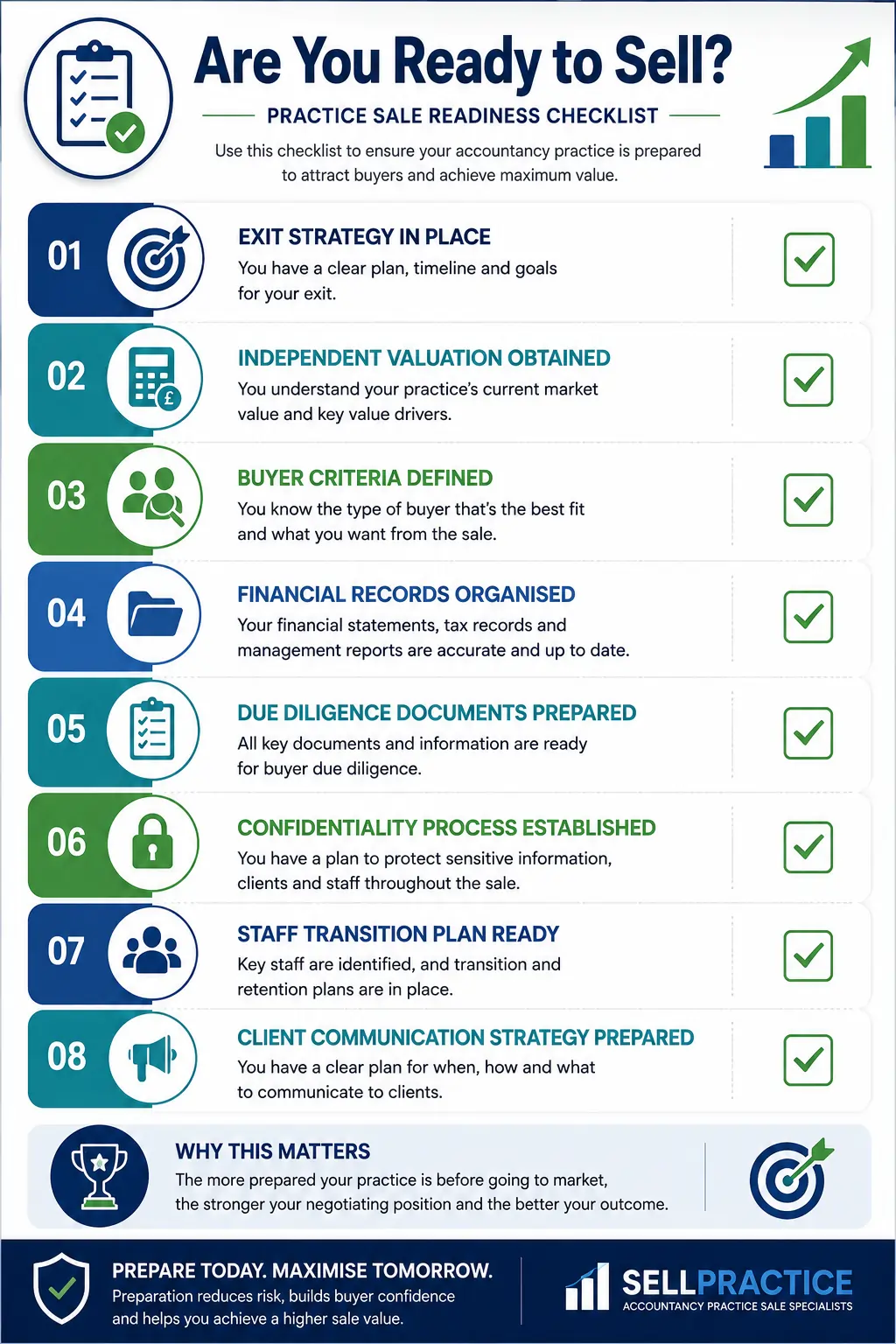
Practice Sale Readiness Checklist
- ✓ Exit strategy in place
- ✓ Independent valuation obtained
- ✓ Buyer criteria defined
- ✓ Financial records organised
- ✓ Due diligence documents prepared
- ✓ Confidentiality process established
- ✓ Staff transition plan ready
- ✓ Client communication strategy prepared
Why This Matters
The more prepared your practice is before entering the market, the stronger your negotiating position becomes.
Preparation reduces risk, improves buyer confidence, and often results in a smoother and more profitable transaction.
Conclusion
Selling an accountancy practice is one of the most important decisions a practice owner will make.
While every transaction is unique, many of the challenges sellers face are surprisingly similar.
Poor preparation, unrealistic expectations, weak buyer selection, confidentiality issues, and inadequate transition planning can all have a significant impact on value and transaction success.
The good news is that these mistakes are largely avoidable.
By planning early, understanding what buyers value, preparing thoroughly for due diligence, protecting confidentiality, and working with experienced advisors, practice owners can significantly improve their chances of achieving a successful outcome.
The most successful sales are rarely the result of luck.
They are the result of preparation, strategy, and execution.
Whether you’re planning to sell next year or several years from now, taking action today can help maximise value, reduce risk, and ensure a smooth transition for your clients, staff, and future owners.
At SellPractice, we help accountancy practice owners navigate every stage of the sale process with confidence, discretion, and expert guidance.