
For many accountants, an accountancy practice is far more than a business.
Key Takeaways
Before beginning the sale process, every accountancy practice owner should understand these core realities about selling a firm in today’s market.
- Buyers pay premium valuations for predictable recurring revenue, not one-off work.
- Practices that rely heavily on the owner personally often receive lower offers.
- Preparing your practice 24–36 months before sale can significantly improve valuation.
- Strong systems, cloud accounting adoption, and staff retention increase buyer confidence.
- Most successful practice sales include a structured transition period after completion.
- Client retention is one of the biggest drivers of valuation and deal structure.
- A practice with organised financials, documented workflows, and stable profitability is substantially easier to sell.
- Selling your practice is not just a financial decision it is an operational and emotional transition that requires careful planning.
It represents years often decades of client relationships, reputation building, long hours, professional trust, and personal sacrifice. In many cases, the practice becomes deeply tied to the owner’s identity. Which is precisely why deciding to sell can feel overwhelming.
Some owners reach the decision because retirement is approaching. Others feel increasing pressure from technology changes, compliance demands, staffing challenges, or burnout. Some realise they no longer want the responsibility of running a growing practice. Others simply recognise that consolidation within the accounting industry has created an attractive market opportunity.
Whatever the reason, one thing is consistently true: the firms that achieve the best outcomes rarely decide to sell suddenly.
The strongest exits are planned carefully and strategically.
In today’s market, buyers are more sophisticated than ever. They are not simply purchasing a list of clients. They are evaluating recurring revenue quality, systems, profitability, staff retention, technology adoption, operational stability, and long-term growth potential.
This guide explains everything accountancy practice owners need to understand before selling:
- how practices are valued
- what buyers look for
- common mistakes sellers make
- how to prepare your firm properly
- how the sale process works
- and how to maximise value before going to market
Whether you plan to sell in six months or three years, understanding these principles now can dramatically improve both valuation and transition outcomes.
Why Accountancy Practice Owners Decide to Sell
There is rarely a single reason behind the decision to sell an accountancy practice.
More often, it is the result of several operational, personal, and industry factors converging over time.

-
Retirement and Succession Planning
The most common driver remains retirement.
Many independent accountants built their firms over 20 to 30 years and now face a difficult reality: there is no obvious successor internally. Younger accountants are increasingly reluctant to take over traditional practice ownership models due to lifestyle priorities, capital requirements, and changing career expectations.
Without a succession strategy, selling becomes the most practical route.
-
Industry Consolidation
The UK accounting market has experienced significant consolidation in recent years.
Larger firms and regional consolidators continue acquiring smaller practices to increase market share, expand geographic reach, and gain recurring fee income. This has created strong demand for well-run practices with stable client bases.
For many owners, this represents an opportunity to exit at attractive valuations.
-
Burnout and Operational Pressure
Running an accountancy practice has become significantly more demanding.
Regulatory compliance, staffing shortages, software transitions, cybersecurity concerns, Making Tax Digital requirements, and increasing client expectations have all added pressure.
Many owners reach a stage where the emotional and operational burden outweighs the rewards of ownership.
-
Technology Changes
Cloud accounting and automation are reshaping the industry rapidly.
Practices that have not modernised systems often face major investment requirements to remain competitive. Rather than undergoing another major transformation phase, some owners choose to sell to firms already operating modern digital systems.
-
Lifestyle Goals
Not every seller is retiring.
Some owners simply want:
- greater flexibility
- reduced stress
- more family time
- freedom to pursue advisory work
- or an opportunity to step away from operational management
Selling can create financial security while allowing owners to transition into a less demanding role.
When Is the Right Time to Sell?
Timing has a major influence on both valuation and deal structure.
One of the biggest mistakes practice owners make is waiting too long.
Many owners begin considering a sale only after growth slows, energy declines, or operational problems begin affecting profitability. Unfortunately, buyers notice these trends immediately.
The best time to sell is usually when the practice still demonstrates:
- stable recurring revenue
- strong client retention
- healthy profitability
- operational consistency
- and visible growth potential
Buyers pay premiums for stability and future opportunity.
Signs Your Practice Is Ready for Sale
A practice is generally attractive to buyers when it demonstrates:
- recurring annual fee income
- long-standing client relationships
- diversified client base
- cloud-based systems
- low client churn
- documented internal processes
- strong staff retention
- reduced dependency on the owner
- consistent year-over-year profitability
Practices that can operate efficiently without heavy daily owner involvement tend to achieve stronger valuations.
Signs You Should Delay Selling
In some situations, delaying a sale by 12–24 months may substantially improve outcomes.
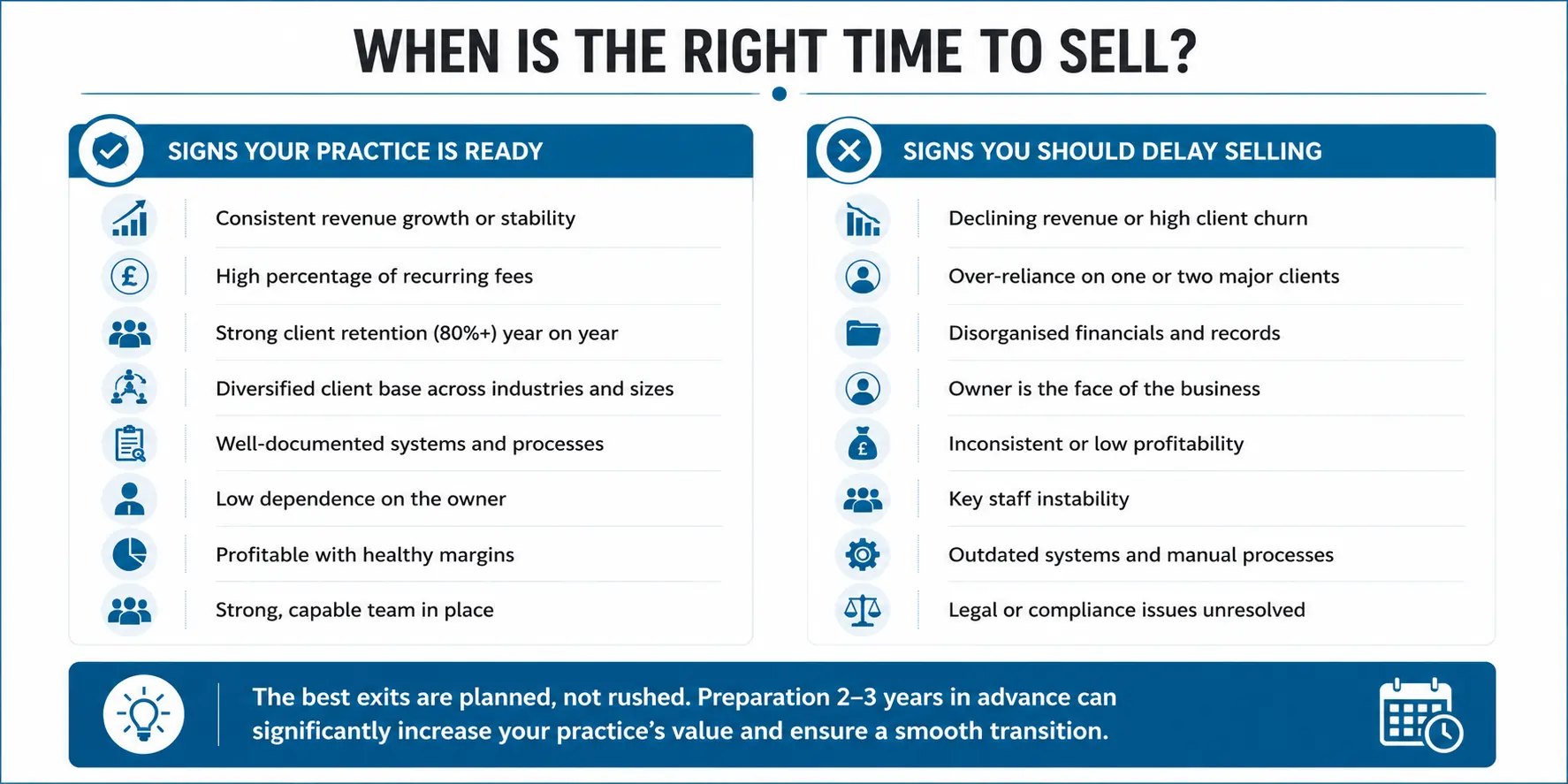
You may benefit from postponing if:
- revenue has recently declined
- a major client represents too much income concentration
- staff turnover is unstable
- financial reporting is disorganised
- the practice depends heavily on you personally
- systems are outdated
- profitability is weak
Improving these areas before going to market can significantly increase buyer confidence and valuation multiples.
How Accountancy Practices Are Valued
One of the first questions sellers ask is:
“How much is my practice worth?”
The answer depends on several interconnected factors.
In smaller accountancy practice acquisitions, valuation is commonly based on a multiple of recurring gross annual fees. Larger firms may also use EBITDA-based valuation models.
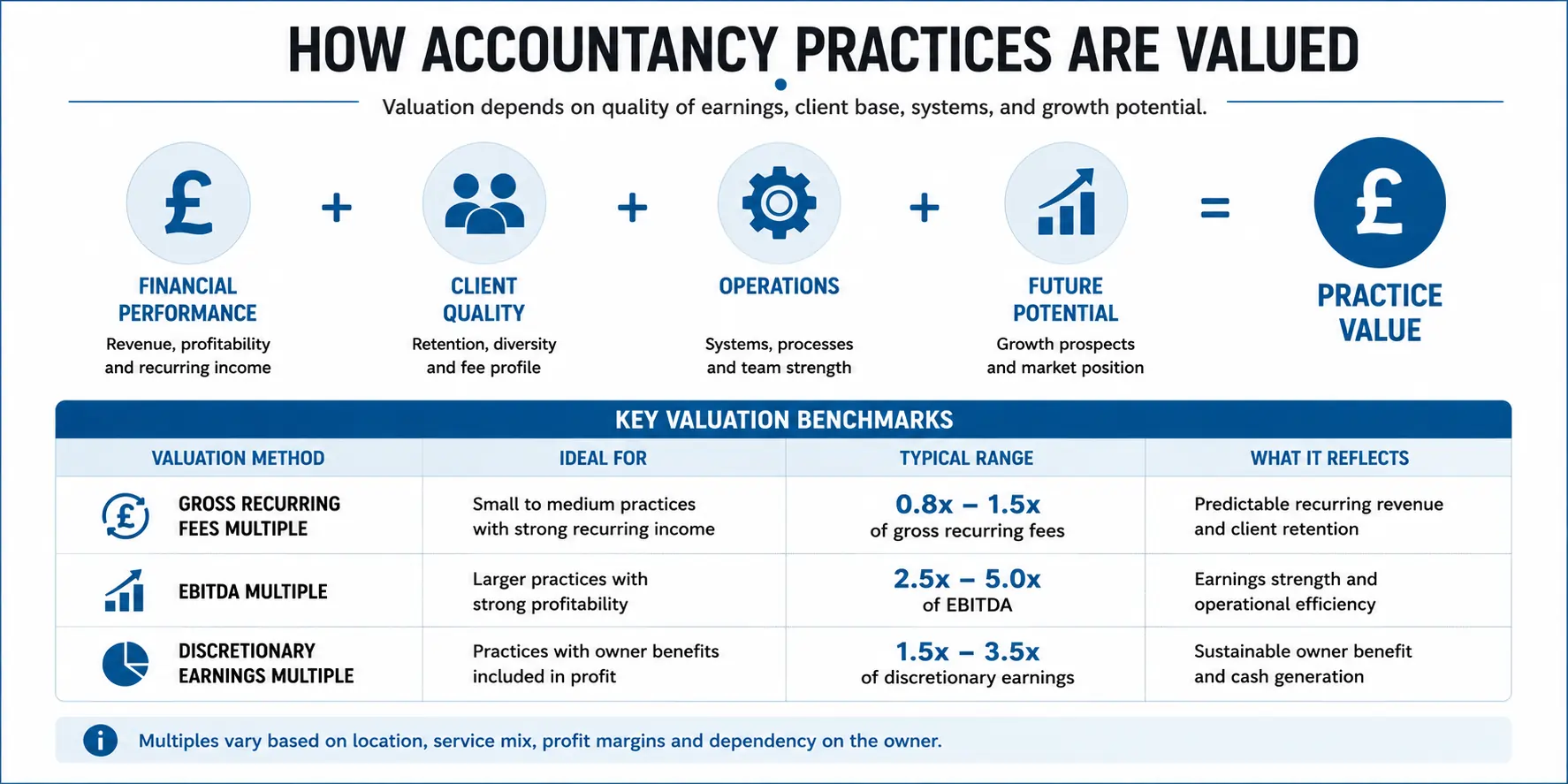
Common Valuation Benchmarks
Typical valuation ranges often fall between:
- 0.8x to 1.5x recurring gross annual fees
- EBITDA multiples for larger and more profitable firms
However, these benchmarks vary significantly depending on quality.
Two firms with identical revenue can receive dramatically different valuations based on operational strength.
The Biggest Valuation Drivers
-
Recurring Revenue Quality
Predictable recurring revenue is one of the most valuable characteristics a practice can have.
Buyers prefer:
- monthly recurring bookkeeping
- payroll contracts
- annual compliance retainers
- advisory retainers
- long-term business clients
One-off project income is generally valued lower.
-
Client Retention and Loyalty
A stable client base reduces acquisition risk.
If clients have remained with the practice for many years and relationships extend beyond the owner personally, buyers gain confidence that revenue will continue after acquisition.
-
Fee Concentration Risk
If one or two clients represent a large percentage of total revenue, the practice becomes riskier.
Diversified income generally improves valuation.
-
Staff and Operational Structure
Experienced staff who intend to remain post-sale significantly strengthen buyer confidence.
Buyers are not only purchasing revenue — they are purchasing operational continuity.
-
Cloud Accounting and Technology Adoption
Practices using modern systems such as Xero, QuickBooks, Sage, and cloud-based workflow management tools are generally more attractive.
Technology maturity reduces integration complexity for buyers.
-
Profitability
Strong margins matter.
A practice generating healthy profits with efficient systems is worth substantially more than a practice producing high revenue but weak profitability.

What Buyers Look For
Buyers are fundamentally looking for predictable income with minimal disruption risk.
They want confidence that the client base will remain stable after acquisition and that the practice can integrate smoothly into their existing operations.
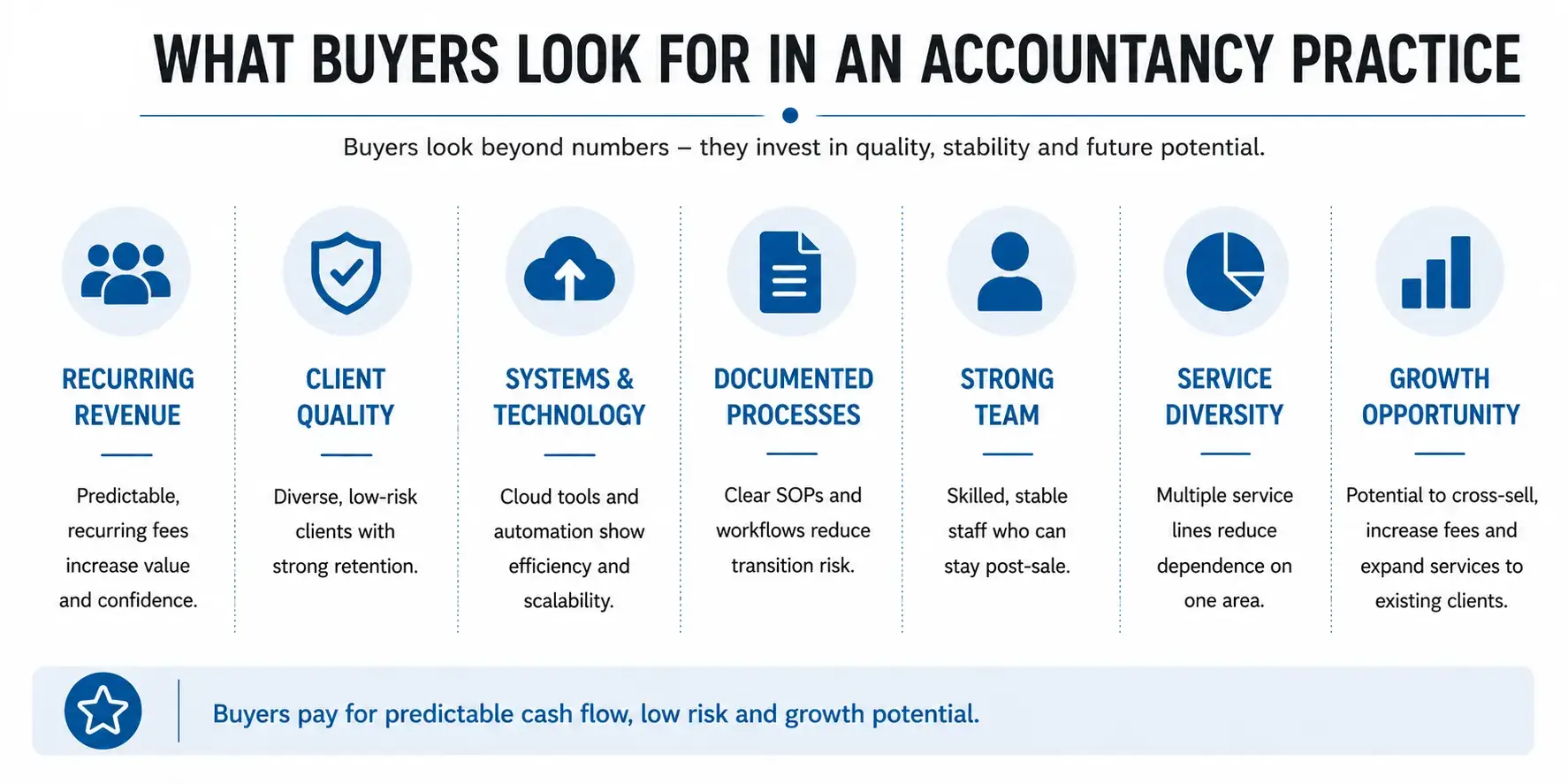
The Characteristics Buyers Prioritise Most
-
Stable Recurring Fees
Recurring compliance and advisory work creates reliable cash flow.
-
Strong Client Relationships
Long-term clients with high retention rates reduce uncertainty.
-
Operational Systems
Documented workflows, onboarding systems, CRM organisation, and standardised processes make transition significantly easier.
-
Staff Stability
Retaining experienced employees after acquisition is critical.
-
Cloud Accounting Adoption
Digital firms are easier to integrate and scale.
-
Growth Potential
Buyers value firms with:
- upselling opportunities
- advisory expansion potential
- niche specialisation
- underserved client segments
- Reduced Owner Dependency
The more the practice relies on the owner personally, the riskier the acquisition becomes.
Practices with delegated client management structures generally receive stronger offers.
How to Prepare Your Practice for Sale
Preparation is where valuation is won or lost.
The strongest sales processes usually begin years before the practice officially goes to market.

-
Organise Financial Records
Your accounts should be:
- accurate
- current
- professionally prepared
- and easy to review
Buyers will analyse:
- revenue trends
- profitability
- recurring fees
- client concentration
- staffing costs
- and operational expenses
Poor financial visibility creates uncertainty and uncertainty reduces value.
Reduce Dependency on Yourself
One of the most important steps is gradually transitioning client relationships toward staff or management.
If every major client depends exclusively on you personally, buyers perceive significant retention risk.
Strengthen Systems and Documentation
Document:
- workflows
- client onboarding
- reporting procedures
- compliance processes
- internal operations
Well-documented practices feel scalable and transferable.
Improve Client Retention
Focus on service consistency and relationship stability.
A practice experiencing increasing client churn before sale will face difficult valuation conversations.
Improve Profitability
Review:
- pricing structures
- unprofitable clients
- inefficient workflows
- unnecessary overheads
Small operational improvements can significantly impact valuation multiples.
Retain Key Staff
Staff departures during the sale process create instability.
Clear communication and retention planning are essential.
Common Mistakes Sellers Make
Even high-quality practices can damage value through avoidable mistakes.

-
Waiting Too Long
Owners sometimes wait until burnout, declining performance, or client loss already affects the business.
The strongest exits are proactive, not reactive.
-
Unrealistic Valuation Expectations
Emotional attachment often causes sellers to overestimate value.
Buyers evaluate measurable commercial risk, not years of effort invested.
-
Poor Financial Visibility
Disorganised reporting creates immediate buyer concern.
-
Overdependence on One Client
Heavy reliance on a single major client increases acquisition risk substantially.
-
No Transition Plan
Buyers want clarity regarding:
- handover timelines
- client introductions
- owner involvement post-sale
- and staff continuity
- Informing Clients Too Early
Premature communication can create unnecessary uncertainty.
Timing and messaging should be carefully managed.
The Practice Sale Process Step-by-Step
Understanding the process reduces uncertainty and helps sellers prepare properly.

Step 1: Initial Valuation
A valuation establishes realistic market expectations.
Step 2: Preparation Phase
Financials, operational documentation, client information, and transition planning are organised.
Step 3: Identifying Buyers
Potential buyers may include:
- regional firms
- consolidators
- local competitors
- private buyers
- or strategic acquirers
Step 4: Negotiation
Discussions typically cover:
- valuation
- payment structure
- transition involvement
- earn-outs
- staff retention
- and client retention protections
Step 5: Due Diligence
Buyers review:
- financial records
- client quality
- contracts
- staffing
- compliance
- and operational systems
Step 6: Legal Agreements
Solicitors formalise:
- purchase agreements
- confidentiality terms
- restrictive covenants
- and transition arrangements
Step 7: Transition Period
Most sales include a handover period to support client continuity.
Step 8: Completion
Ownership transfers formally and agreed payments are completed.
Should You Use a Broker or Advisor?
Many sellers benefit significantly from professional advisory support.
Advantages of Using a Broker or M&A Advisor
Experienced advisors can:
- identify qualified buyers
- maintain confidentiality
- assist negotiations
- improve positioning
- manage timelines
- and reduce emotional decision-making
They also help sellers avoid undervaluing the business.
Potential Drawbacks
Advisory fees reduce net proceeds.
However, stronger deal structures and improved valuation often offset these costs.
For larger or more complex practices, professional guidance is usually worthwhile.
What Happens After the Sale?
Many owners assume the transaction ends immediately after completion.
In reality, most deals involve transition responsibilities.
-
Transition Periods
Sellers often remain involved for:
- several months
- client introductions
- relationship handovers
- operational support
- or strategic advisory input
-
Earn-Out Structures
Some deals include future payments tied to client retention performance.
-
Financial and Tax Planning
Selling a practice can have major tax implications.
Professional tax planning before completion is essential.
-
Emotional Adjustment
For many owners, stepping away from a long-established practice creates unexpected emotional challenges.
Planning your post-sale lifestyle and objectives is equally important.
Conclusion
Selling an accountancy practice is one of the most significant decisions a firm owner will ever make.
The practices that achieve the strongest outcomes are rarely the ones that rush into the market unexpectedly. They are the firms that prepare deliberately, strengthen operations before sale, reduce risk for buyers, and position themselves as stable, transferable businesses.
Buyers are not simply purchasing revenue.
They are purchasing predictable recurring income, operational continuity, client loyalty, and future growth potential.
The stronger those foundations are, the stronger your valuation and negotiation position become.
Whether your goal is retirement, lifestyle flexibility, succession planning, or strategic exit, preparation matters.
The earlier you begin organising your systems, improving profitability, strengthening retention, and reducing owner dependency, the more options you create for yourself when the time comes to sell.
A successful sale is rarely accidental.
It is the result of strategic preparation carried out long before the business officially goes to market.
What documents do buyers usually require?
Typically:
- financial statements
- client fee schedules
- staff information
- contracts
- operational documentation
- and compliance records