
Selling your accountancy practice doesn’t end when you agree on a price. One of the most important stages that follows is buyer due diligence, a detailed review of your practice before the transaction is completed. For many sellers, this is the stage that creates the most uncertainty. What information will buyers ask for? How much detail is required? And how can you prepare to ensure the process runs smoothly?
Understanding what buyers expect can help you prepare in advance, reduce delays, and build confidence throughout the transaction. In this guide, we explain what buyers typically request during due diligence when selling your accountancy practice and how you can get ready for a successful sale.
Key Takeaways
- Due diligence allows buyers to verify the information provided before completing the purchase.
- Buyers assess financial performance, client relationships, operations, compliance, technology, legal matters, and transition planning.
- Well-organised documentation builds buyer confidence and helps speed up the transaction.
- Preparation before due diligence can reduce delays and minimise the risk of renegotiation.
- Working with a specialist advisor helps manage the process efficiently while maintaining confidentiality.
What Is Due Diligence in an Accountancy Practice Sale?
Due diligence is the process buyers use to verify the information provided during the sale of an accountancy practice. Rather than relying solely on discussions or marketing information, buyers examine financial, operational, legal, and compliance records to ensure they fully understand the business they are acquiring.
The objective is not to find faults with the practice. Instead, due diligence helps buyers:
- Verify financial performance
- Confirm operational stability
- Assess client retention risks
- Review legal and regulatory compliance
- Identify any potential liabilities
Think of due diligence as a validation exercise. The more transparent and organised your practice is, the smoother this stage is likely to be.
Why Buyers Request Detailed Information?
Buying an accountancy practice is a significant investment. Buyers need confidence that the practice will continue generating revenue after ownership changes.
Detailed information helps them assess:
- The stability of recurring income
- he quality of the client portfolio
- Profitability and operational efficiency
- Regulatory compliance
- Potential business risks
A practice that provides clear, organised information demonstrates professionalism and gives buyers greater confidence in both the business and the transaction.

Financial Information Buyers Will Request
Financial performance is usually the first area buyers examine. They want to understand not only how much revenue the practice generates but also how sustainable that income is over time.
Typical financial information requested includes:
- Financial statements for the previous two to three years
- Management accounts
- Revenue breakdown by service line (tax, accounts, bookkeeping, payroll, advisory, etc.)
- Client fee schedules
- Profit margins
- Cost structure
- Cash flow information
- Financial forecasts (where available)
Rather than focusing solely on turnover, buyers are looking for consistent profitability and recurring income that is likely to continue after the acquisition.
Client Portfolio Information
In an accountancy practice, the client portfolio is often the most valuable asset. During due diligence, buyers will carefully evaluate the strength and stability of your client base.
Information commonly requested includes:
- Total number of active clients
- Revenue generated by each client
- Client concentration
- Industry sectors served
- Length of client relationships
- Recurring versus one-off work
- Client retention history
Buyers pay particular attention to client concentration. If a large percentage of revenue comes from only a few clients, the perceived risk is generally higher. Practices with diversified, long-standing client relationships are usually viewed as more stable acquisition opportunities.
Staff and Operational Information
The quality of your team plays an important role in the success of any practice acquisition. Buyers want reassurance that experienced employees will remain after completion and that day-to-day operations are not overly dependent on the owner.
Information buyers may request includes:
- Staff roles and responsibilities
- Organisational structure
- Employment contracts
- Salary and benefits information
- Length of service
- Key employee responsibilities
- Staff involvement in client relationships
A capable team supported by clearly defined responsibilities demonstrates that the practice can continue operating successfully following the transition.
Compliance and Regulatory Documentation
Compliance is another critical area of buyer due diligence. Buyers need confidence that the practice operates in accordance with professional and regulatory requirements.
Documentation may include:
- Anti-Money Laundering (AML) policies
- Client engagement letters
- Professional indemnity insurance
- GDPR and data protection policies
- Internal compliance procedures
- Regulatory records
Well-maintained compliance documentation reassures buyers that the practice is professionally managed and reduces concerns about future regulatory risks.
Systems and Technology Overview
Technology has become an increasingly important consideration in accountancy practice acquisitions. Modern systems make practices easier to integrate, improve efficiency, and support future growth.
Buyers often assess:
- Accounting software platforms
- Practice management systems
- Workflow processes
- Client portal solutions
- Document management systems
- Data security measures
- Cybersecurity policies
Practices that have embraced cloud technology and digital workflows are often viewed as more scalable and operationally efficient.

Legal and Contractual Information
Legal documentation provides buyers with a clear understanding of the contractual obligations associated with the practice.
Typical requests include:
- Client contracts and engagement letters
- Supplier agreements
- Office lease agreements (where applicable)
- Software licence agreements
- Outstanding disputes or litigation
- Existing contractual obligations
Being transparent about legal matters from the outset helps prevent surprises later in the transaction and supports a smoother due diligence process.
Transition and Handover Expectations
Due diligence doesn’t end with reviewing documents. Buyers also want to understand how the practice will transition after the sale. A well-planned handover can significantly influence client retention and ensure continuity for both employees and clients. Buyers will often discuss the transition in detail to understand how relationships and operational knowledge will be transferred.
Areas commonly discussed include:
- The seller’s involvement after completion
- Client introduction meetings
- Staff communication and retention
- Knowledge transfer
- Handover timelines
- Ongoing support during the transition period
A structured transition reassures buyers that the practice can continue operating successfully while maintaining the trust of existing clients.
Due Diligence Checklist for Sellers
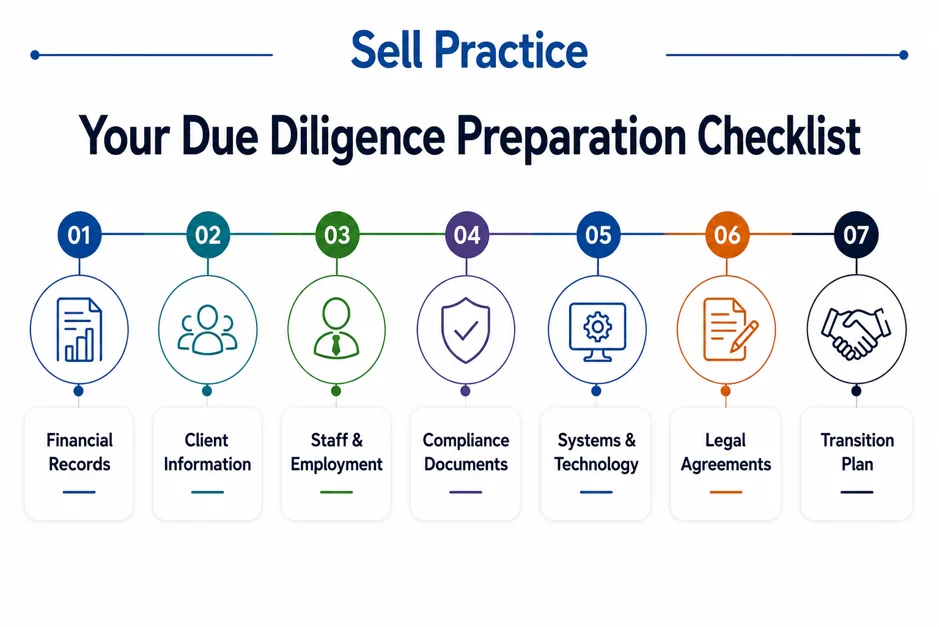
Preparing key information before buyers request it can make the due diligence process faster and more efficient.
| Category | Documents to Prepare |
| Financial | Financial statements, management accounts, revenue reports |
| Clients | Client list, recurring fee analysis, engagement letters |
| Staff | Employment contracts, organisational chart, staff responsibilities |
| Compliance | AML policies, GDPR documentation, professional indemnity insurance |
| Systems | Accounting software details, practice management systems, workflow documentation |
| Legal | Client contracts, supplier agreements, lease agreements, ongoing legal matters |
| Transition | Client communication plan, seller involvement, handover timeline |
Having these documents organised before entering due diligence demonstrates professionalism and helps build buyer confidence from the outset.
How to Prepare for Due Diligence?
The most successful practice sales are rarely those where sellers scramble to gather information after a buyer asks for it. Instead, they are transactions where preparation begins well before the practice is marketed.
To prepare effectively:
- Organise your financial and operational records.
- Review client and compliance documentation for completeness.
- Update employment and contractual records where necessary.
- Ensure policies and procedures reflect current regulatory requirements.
- Prepare summary reports that allow buyers to understand the practice quickly.
- Anticipate the questions buyers are likely to ask.
Being proactive not only speeds up the transaction but also reduces the likelihood of delays or unnecessary renegotiations.
How Sell Practice Supports Sellers During Due Diligence?
Due diligence is one of the most detailed stages of selling an accountancy practice. Managing information requests while continuing to run the practice can be challenging without the right support.
At Sell Practice, we help practice owners prepare for due diligence well before buyer enquiries begin.
Our experienced team supports sellers by:
- Preparing the practice for market
- Identifying gaps before buyers discover them
- Organising documentation for due diligence
- Coordinating information requests
- Managing communication between buyers and sellers
- Maintaining strict confidentiality throughout the process
Our structured approach helps minimise disruption, reduce delays, and keep transactions progressing smoothly from agreement through to completion.
Conclusion
Buyer due diligence is one of the most important stages in selling an accountancy practice. It gives buyers the opportunity to verify the financial, operational, legal, and compliance information that supports their investment decision.
Being well prepared not only builds buyer confidence but also helps accelerate the transaction, minimise delays, and reduce uncertainty for everyone involved. By organising your documentation, understanding what buyers will request, and planning ahead, you can position your practice for a smoother and more successful sale.
If you’re considering selling your accountancy practice, Sell Practice provides confidential guidance and specialist support throughout the due diligence process, helping you prepare with confidence and achieve the best possible outcome.